Stay vs Exit Interview 2026: Differences & When to Use
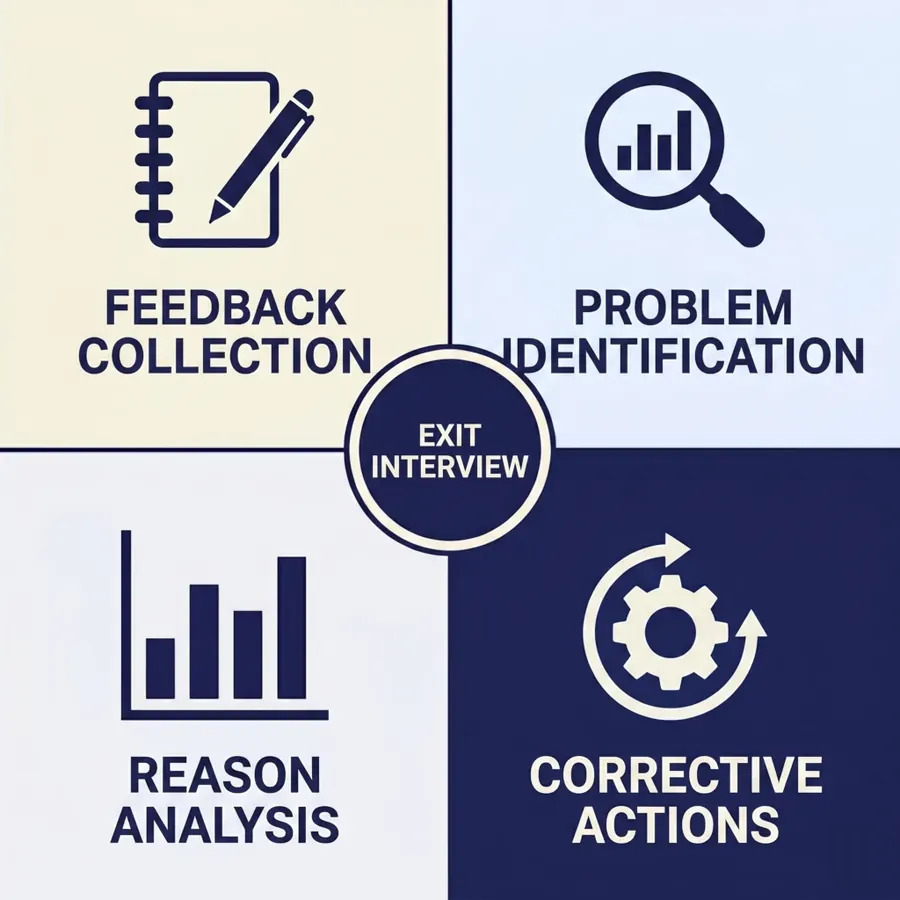
Exit interviews tell you why people already left. Stay interviews tell you why your current people might leave next — while there's still time to do something about it. The honest answer to "stay interview vs exit interview: which one matters more?" (sometimes searched as exit interview vs stay interview) is that you need both, but for very different reasons. Both are pillars of any modern retention strategy for employee retention in 2026 — together they reduce voluntary turnover faster than either alone, while preserving the exit interview meaning as the post-mortem signal it was always designed to be. This guide explains the differences, when to use each, the 15 best stay interview questions, and how to build the integrated retention loop that turns both data streams into measurable retention improvements.
For a deeper foundation on either format, see our complete exit interview guide and the full library of 30+ exit interview questions.
What Is a Stay Interview? Definition and How It Differs From an Exit Interview
A stay interview (sometimes called a retention interview) is a structured 30-minute conversation between a manager (or HR) and a current employee, focused on what's keeping that person engaged and what might cause them to leave. It is proactive: held while the employee is still actively engaged, while the company can still act on the answer.
The structural difference from an exit interview is timing — and that single difference changes everything else:
- Exit interview: post-decision. Diagnostic. Captures sentiment data after the employee has chosen to leave. Useful for pattern detection across cohorts; almost never useful for saving the specific departure being interviewed.
- Stay interview: pre-decision. Preventive. Captures sentiment data while the employee is still in the role and still open to change. Useful for the specific employee being interviewed — and, when run systematically, useful for identifying preventable turnover months before it happens.
According to Gallup, 52% of voluntary leavers believed their manager could have prevented their departure. Stay interviews are the structured mechanism designed to surface those preventable cases before the resignation letter arrives.
Stay Interview vs Exit Interview: 9-Point Comparison Table
| Dimension | Exit Interview | Stay Interview |
|---|---|---|
| When | After resignation, before last working day | Every 6-12 months for tenured employees, every 90 days for new hires |
| Who conducts | Best: third-party or AI. Worst: direct manager. | Best: direct manager (intentionally). HR follows up if needed. |
| Goal | Diagnose patterns across departures | Prevent the specific departure being interviewed |
| Question style | Past-focused: "why are you leaving?" | Present and future-focused: "what's keeping you?" "what would make you leave?" |
| Honesty challenge | Social desirability bias, fear of burning bridges | Reluctance to flag dissatisfaction to current manager |
| Actionability | Aggregate-level (themes across many departures) | Individual-level (immediate actions for this person) |
| Owner of follow-up | HR / People Analytics | Direct manager + HR for cross-team patterns |
| Cost per interview | $1-5 (AI) to $300+ (third-party phone) | $50-100 (manager time, no tooling cost) |
| Frequency per employee | Once, at departure | 1-4 times per year throughout tenure |
Why Stay Interviews Are More Powerful for Retention (and Where Exit Interviews Still Win)
The case for stay interviews: timing changes everything
The single biggest argument for stay interviews is the same argument that rules out exit interviews as a retention tool: by the time someone is doing an exit interview, the decision is irreversible. Counter-offers at the resignation stage have a notoriously poor success rate (most counter-offer-accepted employees leave within 6-12 months anyway). The only retention tool that actually retains people is one used before the decision is made.
Stay interviews work because they happen while you still have the ability to change the outcome. The conversation reveals what would push the employee out and — equally important — what would push them to stay longer. That information feeds directly into manager 1:1s, comp reviews, growth plans, and team-level changes. Multiple Work Institute and Gallup studies link systematic stay interview programs with retention improvements of 15-25% within 12 months.
The case for exit interviews: pattern detection and accountability
Stay interviews can't replace exit interviews — they answer a different question. Exit interviews surface aggregate patterns across many departures: which managers, which teams, which policies, which compensation issues are systematically driving losses. They also produce the data needed to hold leaders accountable: when 5 engineers in 6 months cite the same VP as the primary departure reason, that's a pattern no individual stay interview would have surfaced.
The right framing isn't "which is better" — it's "what does each do that the other can't":
- Stay interviews: prevent the specific person you're talking to from leaving.
- Exit interviews: prevent the next 10 people from leaving for the same systemic reason.
15 Best Stay Interview Questions (with the "Why" Behind Each)
A good stay interview is conversational, not a checklist. The 15 questions below are organized into five categories. In a real interview, the manager picks 5-8 questions across the categories and follows up wherever the employee opens a door.
Category 1: Engagement and meaning
- "What are you most enjoying about your role right now?" Surfaces what's working — both for the employee and as a signal of what to protect or expand.
- "When was the last time you felt genuinely energized at work? What were you doing?" Anchors the answer to a specific moment, which produces more concrete data than abstract "how engaged are you" questions.
- "What part of your work do you find most meaningful — and how can we have more of it?" Forces the conversation past tasks into purpose.
Category 2: Manager and growth
- "What's the single most useful thing I do as your manager? What's the single least useful?" Most managers never get this feedback. The "least useful" half is the goldmine.
- "What career opportunities are you most interested in over the next 12-24 months — inside this company or outside?" Naming the "outside" option openly is what makes the answer honest.
- "What's one skill you'd like to develop that we're not currently giving you the chance to build?"
Category 3: Risks and friction
- "What would tempt you to leave?" Direct, concrete, hard to deflect. Often the most important question in the entire conversation.
- "What's frustrating you right now that I can help fix in the next 30 days?" Forces specificity and a time frame for action.
- "Is there any part of your job that you're losing energy for?" Detects burnout drift before it becomes a resignation.
Category 4: Recognition and compensation
- "Do you feel fairly recognized for your work? What kind of recognition would matter most to you?" Recognition preferences vary widely; never assume.
- "How fair do you find your compensation relative to the market and to peers in similar roles here?" Better to surface compensation concerns in a stay interview than wait for a counter-offer scenario.
Category 5: Future and signal
- "If you could change one thing about how this team works, what would it be?"
- "What's one decision the company has made in the last 6 months that you disagreed with — and what was the impact on you?" Surfaces silent dissent that often predicts disengagement.
- "On a scale of 0-10, how likely are you to still be here in 12 months? What would make that number higher?" The closest thing to a leading-indicator turnover metric you can get.
- "What haven't I asked that you wish I would?" The closing safety-net question. Often produces the answer the employee was hoping to give from the start.
The Integrated Retention Loop: How Stay and Exit Interviews Reinforce Each Other
Run separately, both stay and exit interviews produce useful but isolated data. Run together as a closed loop, they become the most powerful retention system available to a mid-market HR team. The integrated loop has four steps.
Step 1: Run exit interviews to identify patterns
Quarterly aggregation of exit interview themes surfaces the recurring drivers of voluntary departures: specific managers, specific competencies, specific policies, specific cohorts. AI-driven thematic synthesis makes this possible at scale — see our guide to AI exit interview automation for the technical detail.
Step 2: Convert exit themes into stay interview questions
Exit themes inform what to probe in upcoming stay interviews. If exits surface a specific manager pattern, stay interviews on that manager's team should probe the same dimensions before the next departure. If exits surface a comp-fairness theme in a specific role family, stay interviews with that role family should explicitly ask about peer comparison.
Step 3: Run stay interviews on at-risk cohorts first
Not every employee needs a stay interview every quarter. Prioritize: (1) high-performers in roles with industry shortage, (2) employees in cohorts that match exit interview risk patterns, (3) employees who have just had a manager change or major scope change, (4) employees in their first 12 months. The goal is preventive coverage where the marginal return is highest.
Step 4: Close the loop with visible action
The single most-skipped step in both formats. When changes happen because of stay or exit interview themes, communicate the change visibly to the broader team: "We heard repeatedly that promotion calibration was unclear. Here's what changed." Future interviews will be more candid because employees will see the pattern: candid feedback produces visible change.
Common Mistakes in Stay Interview Programs (and How to Avoid Them)
- Letting the manager skip the conversation. The whole point is the conversation between manager and employee. Outsourcing it to HR removes the value.
- Making it feel like a performance review. Stay interviews are about the employee's experience, not the company's evaluation of them. Different conversation, different room, different framing.
- Asking but not acting. The fastest way to destroy trust is to ask "what would tempt you to leave" and then do nothing about the answer. Either commit to acting on the data or don't run the program.
- Running them too frequently. Quarterly is the upper limit for tenured employees. Monthly destroys signal — every conversation feels routine and the employee stops engaging deeply.
- Treating the data as confidential to the manager only. Cross-team patterns matter. Aggregate stay interview themes (without individual attribution) should reach HR for organizational pattern detection.
- Skipping new hires. The first 12 months are the highest-risk window. New hire stay interviews at 30-60-90 days catch onboarding failures before they become resignations.
Stay Interview Template: 30-Minute Conversation Structure
A practical 30-minute structure for the manager:
- 0-5 min — Frame the conversation. "This is a stay interview, not a performance review. I'm trying to understand what's working, what's not, and what would keep you here longer. Anything you say stays in this conversation unless I have your permission to escalate."
- 5-15 min — Engagement and growth. Pick 2-3 questions from Categories 1 and 2 above. Listen more than you talk.
- 15-25 min — Risks and frustrations. The hardest part. Ask "what would tempt you to leave" directly. Probe specifics.
- 25-30 min — Commitments. Identify 1-2 specific actions the manager will take in the next 30 days based on what was discussed. Write them down. Follow up in the next 1:1.
For a full stay interview template in PDF, Excel and Google Forms — including the manager's preparation checklist and a follow-up tracker — see the bundled KS-Agents free HR templates kit.
FAQ: Stay Interview vs Exit Interview
What is the difference between a stay interview and an exit interview?
A stay interview is held with a current employee while there's still time to act on the feedback; an exit interview is held with a departing employee after the decision to leave is final. Stay interviews prevent the specific departure being interviewed; exit interviews surface aggregate patterns across many departures.
Should you do stay interviews or exit interviews?
Both, for different reasons. Stay interviews catch preventable departures while you can still intervene; exit interviews surface the systemic patterns that are driving the next cohort of losses. Companies that do only one are leaving 50% of the value on the table.
Who should conduct a stay interview?
The direct manager — intentionally. The whole point is to strengthen the manager-employee relationship and produce immediately-actionable changes the manager can own. HR involvement is appropriate for cross-team patterns and for cases where the manager is the source of the problem (in which case the manager's own manager or HR should run it).
How often should stay interviews happen?
Tenured employees: every 6-12 months. New hires: at 30, 60, and 90 days, then quarterly through the first year. After major changes (manager change, reorg, M&A): within 30 days of the change. Monthly is too frequent and destroys signal.
What's a good stay interview question to start with?
"What's the single most useful thing I do as your manager — and the single least useful?" It opens the conversation honestly, signals that you're inviting real feedback, and produces immediately-actionable data on the manager-employee relationship.
Will employees answer stay interview questions honestly?
Mixed — and that's the limit of the format. Some employees will be candid; others will hold back if they don't yet trust the manager or the process. Trust builds with each cycle when employees see honest answers produce visible change. The first round of stay interviews almost always produces shallower data than the third round.
Can AI conduct stay interviews like it can conduct exit interviews?
Technically yes, but the value is lower. The whole point of stay interviews is the conversation between manager and employee, not just the data extraction. AI is better suited as a preparation tool (suggesting questions to probe based on past patterns) and as an aggregation tool (synthesizing themes across many manager-conducted stay interviews) than as the interviewer itself.
What's the ROI of running both stay and exit interviews?
Companies running both report retention improvements of 20-30% within 12 months — meaningfully better than running either alone. The mechanism: exit interviews identify the patterns; stay interviews intervene before the patterns become departures; the closed loop makes both signals stronger over time.
How do I get manager buy-in for stay interviews?
Frame it as a retention insurance policy: a 30-minute conversation now beats a 6-month replacement search later. Pair it with measurable accountability — managers' team retention metrics should reflect stay-interview follow-through. The managers who resist hardest are usually the ones whose teams are about to lose people.
Are stay interview questions different from engagement survey questions?
Yes, in two ways. (1) Stay interviews are conversational and adaptive; engagement surveys are static and quantitative. (2) Stay interviews focus on what would change the employee's mind about leaving; engagement surveys measure the current sentiment baseline. Both are useful; they answer different questions.
From Diagnosis to Prevention — Build the Integrated Retention Loop
Exit interviews diagnose; stay interviews prevent. Run alone, each is a partial answer. Run together as a closed loop — with quarterly exit aggregation feeding the questions asked in stay interviews on at-risk cohorts, and with visible action closing the loop publicly — they become the most effective retention system available to a mid-market HR team in 2026.
KS-Agents 360 Unlimited Starter includes both AI-powered exit interviews AND stay interview tooling — pre-configured templates, AI-driven aggregation, manager preparation prompts, and the integrated retention loop dashboard. Free forever for teams up to 10 employees, EU data residency, GDPR + AI Act compliance built in. Start your retention loop today →
For deeper exploration: read our complete exit interview guide, browse the library of 30+ exit interview questions and examples, dive into why AI-powered exit interviews beat traditional HR formats, and explore the strategic cost of knowledge loss in employee turnover and how to stop brain drain through structured knowledge retention.
References
- Gallup. (2025). State of the Global Workplace Report.
- Work Institute. (2025). Stay Interviews vs Exit Interviews: Which Matters More for Retention?
- AIHR. Your In-Depth 2026 Guide to Stay Interviews.
- Culture Amp. Stay Interviews: Your Key to Retaining Top Performers.
- Mercer. (2025). US Turnover Survey.
- SHRM. Making Exit Interviews Work.
Capture Knowledge with Torch
Preserve critical company know-how with automated SOP generation and structured exit interviews.
Discover Torch