The conversations
your organization doesn't have.
Seven in ten US employers run exit interviews — only one in four leaders trusts the data they collect (Spain & Groysberg, Harvard Business Review, 2016). The constraint is operational: a trained interviewer who probes consistently is expensive and scarce. KS-Agents conducts the interview itself — adaptive in real time, structured at the output, repeatable at every transition.
Structured interviewing, finally at the scale of the workforce.
Structured interviews predict workplace outcomes more than twice as well as unstructured ones (Sackett, Zhang, Berry & Lievens, Journal of Applied Psychology, 2022). The discipline is well known. The reason it stays under-applied is that running it consistently requires a trained interviewer at every conversation — a capacity that does not exist at organizational scale.
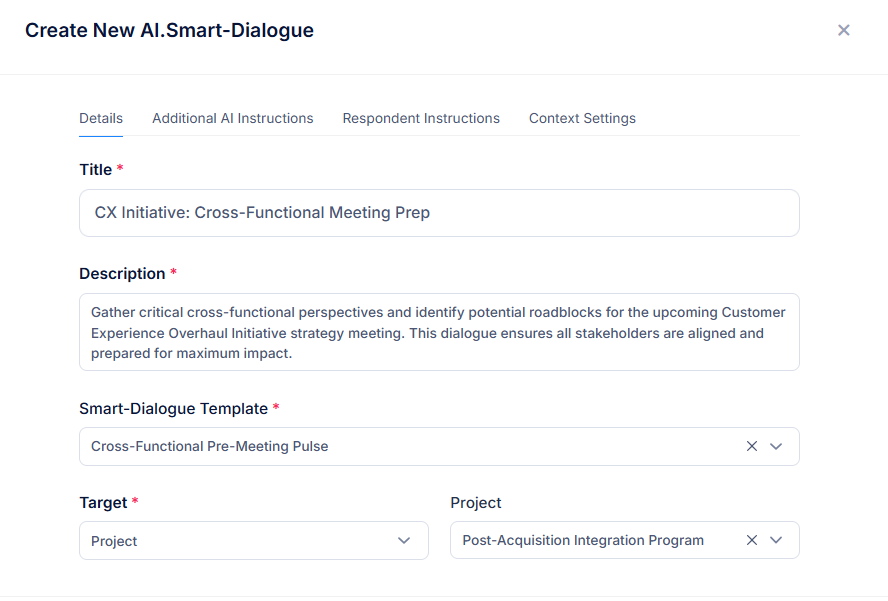
KS-Agents conducts the interview under the template you define:
- Author the objective, tone, scope and probe rules once. The template is reused across cohorts without drift.
- Each follow-up is generated from the participant's actual answer — the probe discipline is constant across every interview in the programme.
- Knowledge base attached at template level: the agent reasons over your policies, prior decisions and project context inside the conversation.
- Guardrails, refusal behaviour and disclosure boundaries are configurable per template — and visible in the audit.
Tacit knowledge surfaces only when you probe the vague answer.
What experienced employees know but cannot easily articulate — Polanyi's paradox, the binding constraint on routine knowledge transfer (Autor, NBER Working Paper 20485, 2014) — escapes static forms. The bridge from tacit to explicit always requires one more question, calibrated to the previous answer.
The agent makes that judgement call in real time:
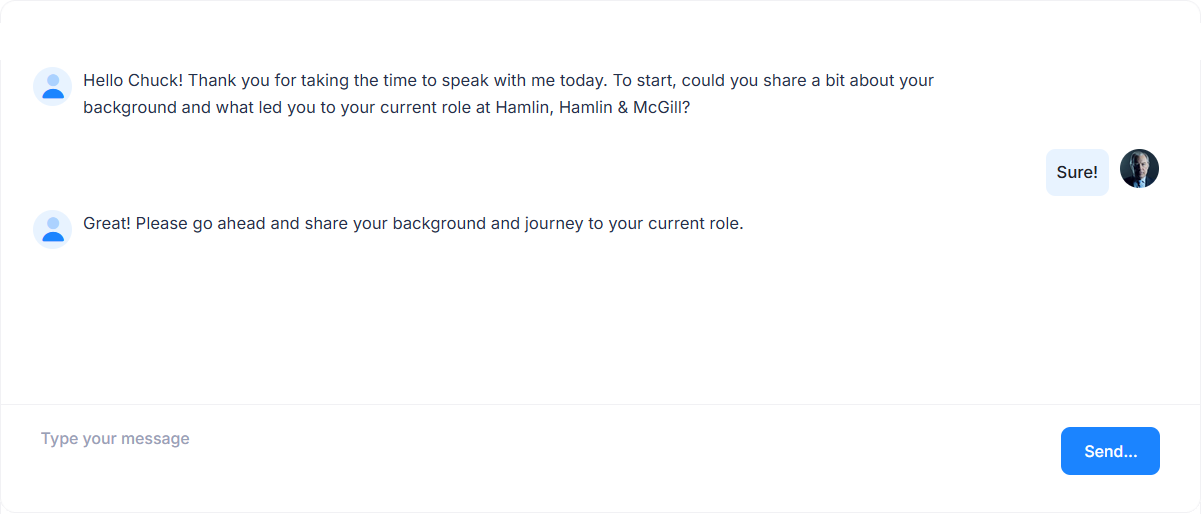
- Catches generic answers ('the team is fine') and asks for the specific moment, decision or person behind them.
- Flags contradictions with prior answers in the same session — without confronting the participant.
- Reasons against organizational context: structure, role, tenure, prior interactions.
- Cross-references aggregated, anonymised insights from peer interviews when the signal warrants it.
- Raises critical-response alerts the moment something requires human attention — distress signals, integrity concerns, regulated content.
Briefs the leadership team reads. Transcripts available if forensics require them.
Spain & Groysberg attributed the credibility gap of exit interviews precisely to the synthesis failure: raw transcripts produced, no actionable summary returned to managers, no feedback loop. Useful data over-produced and under-decided-on.
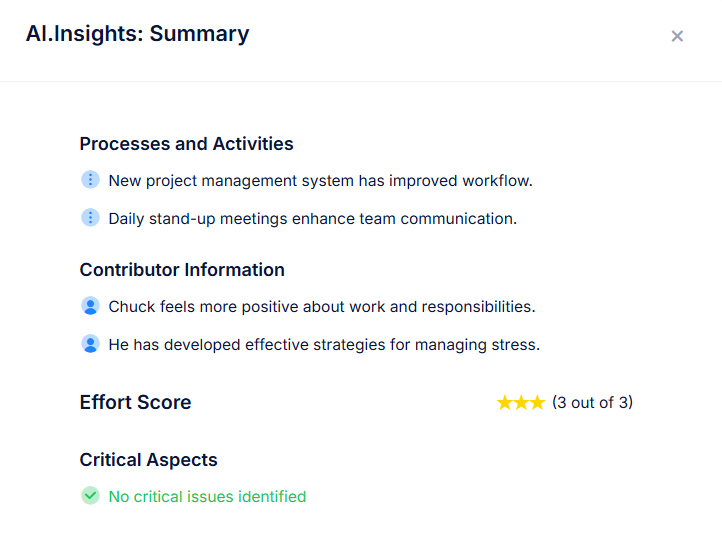
Each session closes into a structured deliverable:
- Brief keyed to the template's objectives — what was asked, what was learned, what is unresolved.
- Themes, sentiment classification and illustrative direct quotes preserving the participant's voice.
- Risk flags surfaced for human review — never auto-actioned.
- Trend rollups across cohorts, departments and time windows — pattern visible only when the listening becomes continuous.
- Export to CSV, PDF, or pipe into downstream analytics. The transcript remains available for review where forensics demand it.
When the marginal cost of one more interview approaches zero.
Programmes typically operated on the engine:
- Exit Interviews
- Stay Interviews
- Onboarding Check-ins
- Candidate Screening
- Performance Reviews
- Leadership 360°
- Expert Knowledge Capture
- Project Retrospectives
- Pre-Meeting Briefings
- Team Climate Pulses
- Change-Management Listening
- NPS Follow-Up Deep-Dives
- Compliance & Incident Intake
- Well-Being & Burnout Screening
- Training Needs Analysis
- Customer Discovery
- Internal NPS & D&I Pulses
- Innovation & Idea Intake