30+ Exit Interview Questions & Examples (2026)
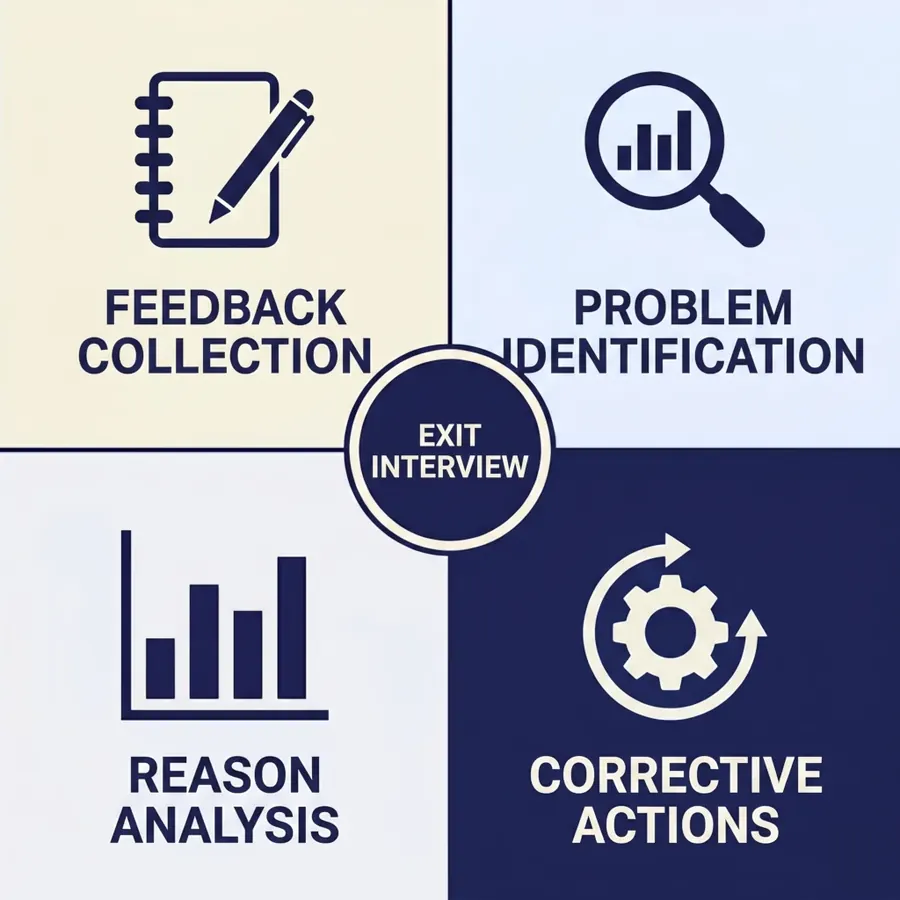
The questions you ask in an exit interview shape every downstream insight: what you learn about your retention problems, what changes you make to keep the next cohort, and whether the 30 minutes the departing employee spent with you produces actionable data or polite filler. Exit interview questions matter as much as — arguably more than — the format they're delivered in.
This guide gives you 30+ research-backed exit interview questions organized by the five categories every program should cover, with downloadable exit interview questionnaires and a complete employee exit survey in PDF, Excel and Google Forms. The same content also works as an exit interview survey for fully-anonymous online distribution, with multiple exit survey examples and exit interview survey examples for different role types — including a working example of an exit interview in Section 7 below. Every question is grounded in best practices from SHRM, AIHR, Culture Amp, Robert Half and Work Institute research — not vendor opinion. We also include 3 real-world exit interview examples that show the difference between surface-level and probing questions, plus dedicated sections for intern exit interview and internship exit survey design.
If you need to move fast, skip ahead to download all 30+ questions as a free PDF, Excel, or Google Forms template. New to exit interviews? Start with our complete exit interview guide covering process, anonymity, and GDPR compliance.
What Makes a Good Exit Interview Question?
Most exit interview questionnaires fail because the questions are designed to be easy to answer, not designed to extract honest insight. A bad question — "Were you happy here?" — invites a polite "yes, mostly". A good question — "What was the single moment in the last 6 months when you most seriously considered leaving?" — forces a specific, datable answer.
Effective exit interview questions meet four criteria:
- Specific: tied to a single decision, behavior, or moment — not a general impression.
- Behavioral: focused on what happened (or didn't), not on how the employee feels in the abstract.
- Datable: anchored to a time window or specific event the employee can recall.
- Decomposable: forcing primary + contributing factors instead of a single masking reason.
Research from the Work Institute on employee turnover shows that 75% of voluntary departures are preventable — but only when the exit interview surfaces the actual decision moment, not the rationalization the employee constructed afterwards. The questions below are designed to do exactly that.
The 80/20 question format split
Aim for ~80% structured questions (Likert 1-5 or multiple-choice) and ~20% open-ended. Structured questions enable benchmarking across departures and time. Open-ended captures the context that makes the data actionable. Pure-survey programs that skip open-ended fields produce clean dashboards with low signal; pure-conversational programs that skip structured fields produce rich anecdotes with no aggregation.
Category 1: Reasons for Leaving (Primary and Contributing)
The most-asked category and the one most often asked badly. Single-reason answers ("better opportunity") almost always hide multiple contributing factors. Force decomposition.
1. Primary reason (forced multi-factor)
"What are the top three reasons you decided to leave, ranked by importance?"
Why it works: the plural ("three reasons") forces the employee past the safe top-line answer. Ranking forces prioritization, which exposes the actual trigger vs the supporting context.
2. The decision moment
"What was the moment or event that made you decide to start looking for another role?"
Why it works: anchors the answer to a specific moment. Decision moments are usually traceable to a specific manager interaction, a missed promotion, an unfulfilled promise, or a structural change. Surface answers ("I was just ready for something new") rarely survive this question.
3. The threshold question
"What would have had to change for you to stay another 12 months?"
Why it works: forces a specific concession. The answer reveals the actual pivot point — often something modest the company could have offered. This is the question that turns exit data into retention strategy.
4. Departure timing
"How long have you been seriously considering leaving?" Options: less than 1 month / 1-3 months / 3-6 months / 6-12 months / more than 12 months.
Why it works: maps the leading indicator window. Most voluntary departures are decided 3-6 months before the resignation letter. If your engagement surveys aren't catching that signal, you have a survey design problem.
5. External pull vs internal push
"On a scale of 1-5, how much was your decision driven by attraction to the new opportunity vs. dissatisfaction with the current one?" 1 = entirely external pull / 5 = entirely internal push.
Why it works: distinguishes preventable internal-push departures (where the company could have intervened) from external-pull departures (where the offer was simply better). Gallup data suggests 60-70% of voluntary departures have a meaningful internal-push component.
Category 2: Manager and Leadership
According to Gallup, 52% of voluntary leavers believe their manager could have prevented their departure. The manager category is the single largest source of preventable turnover signal in any exit interview. Questions should probe specific behaviors, not personality traits.
6. Feedback frequency
"How often did your direct manager give you feedback on your performance — outside of formal reviews?" Options: weekly / monthly / quarterly / only at formal reviews / never.
7. Career advocacy
"Did you feel your manager actively advocated for your career growth — promotions, visibility, stretch opportunities?" Likert 1-5 + open-ended example.
8. Difficult conversations
"How well did your manager handle difficult conversations: underperformance, conflict, missed expectations?"
9. Psychological safety
"How safe did you feel raising concerns, mistakes, or unconventional ideas with your manager?"
10. Manager intervention attempts
"Did your manager have any conversation with you about retention before you submitted your resignation? If yes, what was offered or proposed?"
Why it works: surfaces whether the manager spotted the risk in time. A "no" answer here is a leading-indicator signal for any other manager on the same team.
11. The "stop doing" question
"If you could ask your manager to stop doing one specific thing, what would it be?"
Category 3: Role, Team and Culture
Cultural mismatch is often diagnosed late and costs months of mutual frustration. These questions probe whether the role-as-sold matched the role-as-experienced.
12. Role accuracy at hiring
"How accurately did the role description and interview process represent what your day-to-day actually looked like?" 1 = completely inaccurate / 5 = completely accurate.
13. Tools and resources
"Did you have the tools, training, and resources to be successful in your role? What was missing?"
14. Team dynamics
"How would you describe the team dynamics — communication, conflict handling, recognition, inclusion?"
15. Cultural fit
"Were the company's stated values reflected in day-to-day behavior? Where was the biggest gap between what was said and what was done?"
16. Workload sustainability
"Was your workload sustainable over the past 6 months? If not, what specifically caused it to be unsustainable?"
Category 4: Compensation, Benefits and Growth
Compensation is the most-cited departure reason but often masks growth or recognition issues. Ask about both.
17. Compensation fairness
"How fair did you find your compensation relative to (a) the market for your role and (b) peers in similar roles inside the company?" Two separate Likert 1-5 questions.
18. Benefits relevance
"Which benefits were genuinely valuable to you, and which felt like noise or were irrelevant to your situation?"
19. Growth path
"Did you have a clear understanding of your potential growth path here? Was the path realistic given the team's structure?"
20. Promotion calibration
"If you sought a promotion that didn't happen, what feedback were you given on the gap? Was that feedback specific and actionable?"
21. Learning and development
"Did you feel you were learning and developing professionally? What stretch opportunities were available to you that you actually used?"
Category 5: What Would Have Changed Your Mind (and the Open-Ended Block)
The most underused and most actionable category. These questions are best delivered as open-ended at the end of the interview.
22. Single biggest change
"What's the single biggest change the company could make that would have kept you?"
23. The hidden strength
"What does the company do well that you'll miss?"
24. The blind spot
"What does leadership not see that you wish they could?"
25. Recommendation likelihood
"On a scale of 0-10, how likely are you to recommend this company as a place to work? What would have made it a 10?"
This is essentially an employee NPS at the moment of departure — a powerful trend metric quarter-over-quarter.
26. Returning
"Under what circumstances would you consider returning to this company in the future? (Different role, different manager, different team, different company conditions, never.)"
The "boomerang employee" data is increasingly valuable — Gallup research shows boomerangs have 30% higher tenure than fresh hires when they return.
27-30. The open-ended block
Standard 4 prompts to close the interview:
- Start: what is the single most important thing the company should start doing?
- Stop: what is the single most important thing the company should stop doing?
- Continue: what is the company doing well that should absolutely continue?
- One ask: if you could change one specific thing about how this company treats its people, what would it be?
Bonus: 5 Questions for Intern Exit Interviews and Internship Exit Surveys
An intern exit interview (sometimes called an internship exit survey) covers different ground than a full-time departure. Interns aren't usually leaving because of compensation or growth — they're leaving because the program ended. The data you want is whether the internship was a strong recruiting funnel for full-time hires and how it compared to other intern offers in market.
- "Did this internship match what you expected when you accepted the offer?" Likert + open.
- "Would you accept a full-time offer from this company today? Why or why not?"
- "How did the work, mentorship, and team experience compare to other internships you considered?"
- "What's the single thing this internship program could improve that would make you more likely to recommend it to peers?"
- "On a scale of 0-10, how likely are you to apply for a full-time role here in the next 2 years?"
Question 32 is the single most important data point in any internship program — the intern-to-FTE conversion intent rate. If that number is below 60% you have a recruiting funnel problem worth investigating in detail.
Real Exit Interview Examples: 3 Scenarios with the Question That Cracked Them Open
The following exit interview examples show how a single well-designed question can transform a polite, useless interview into actionable retention data. All three are based on real (anonymized) departures from European mid-market companies.
Example 1: The "compensation" departure that wasn't really about money
Surface answer (HR exit interview): "I'm leaving for a 25% comp increase at a Series B startup."
Question that cracked it open: "What would have had to change for you to stay another 12 months?"
Real answer: "If I'd been promoted in this last cycle, I would have stayed. The gap to my new offer would have been 8% instead of 25%, and I would have taken less to stay with people I knew. Two peers with worse delivery records got promoted ahead of me. When I asked my manager what specific gaps to close, the answer was vague. I started interviewing externally the next week."
Actionable signal: broken promotion calibration process and a manager who couldn't articulate development priorities. Compensation was a secondary driver, not the trigger.
Example 2: The "personal reasons" departure with a specific operational cause
Surface answer: "Personal reasons. I want more flexibility for my family."
Question that cracked it open: "What was the moment or event that made you decide to start looking for another role?"
Real answer: "March 14, 2025. New VP announced 4-day office requirement on a Slack post at 5pm Friday. No consultation. No exception process. I have a 6-month-old at home. I started interviewing the following Monday."
Actionable signal: a specific decision by a specific VP, made without consultation, that triggered identifiable departures. The company had no idea this single Slack post had cost them three senior people in the following 90 days until exit interviews surfaced the pattern.
Example 3: The "no specific next step" burnout departure
Surface answer: "Just need a break. No specific next step."
Question that cracked it open: "How long have you been seriously considering leaving, and was there an event that triggered the decision?"
Real answer: "Eight months. The trigger was the third time I raised the under-resourcing issue in 1:1s with my manager and was told 'we hear you, we're working on it'. After the third time I stopped raising it and started planning my exit. The team has lost two senior people who were never backfilled. I'm exhausted and I gave up trying to fix it."
Actionable signal: not a personal-burnout story but a structural under-resourcing pattern, plus a manager who acknowledged the problem repeatedly without escalating. Both are addressable; both were invisible until the right exit interview question surfaced them.
Common Mistakes to Avoid in Exit Interview Question Design
1. Vague feeling-based questions
❌ "Were you happy here?"
✅ "What was the moment in the last 6 months when you most seriously considered leaving?"
2. Single-cause framing
❌ "Why are you leaving?"
✅ "What are the top three reasons you decided to leave, ranked by importance?"
3. Loaded or leading questions
❌ "How much will you miss our incredible culture?"
✅ "What does the company do well that you'll miss? What were the gaps between stated culture and lived experience?"
4. Double-barreled questions
❌ "How was your relationship with your manager and your team?"
✅ Two separate questions: one on the manager, one on the team.
5. Asking only about the future
❌ "What's your next role?"
✅ This wastes the unique window into the past. Ask about the past in detail; the future is usually irrelevant to your retention strategy.
6. No threshold or what-if questions
❌ Surveys that only ask "what was wrong" without asking "what would have changed your mind".
✅ Always include the threshold question — it reveals the pivot point that defines actionable retention strategy.
Free Exit Interview Templates: Download All 30+ Questions in Your Format
We've packaged the 30+ questions above (plus the 5 intern-specific questions) into three editable formats so you can launch your exit interview process today — no software purchase required. Each template is GDPR-compliant out of the box, with the required confidentiality and data-use disclaimers built into the cover sheet.
- PDF (printable, all questions categorized) — perfect for in-person interviews, training sessions, and HR documentation.
- Excel template (sortable, with built-in scoring formulas and theme-tagging columns) — clone, customize, and use immediately for small-team rollouts.
- Google Forms template (clone-and-customize, anonymized response collection configured correctly) — share with departing employees in minutes, with the anonymity settings already set per the rules in our complete exit interview guide.
→ Download all three exit interview templates (free, no credit card)
How AI Generates Custom Exit Interview Questions for Your Company
Generic templates work as a starting point, but every organization has unique cultural contexts, role types, and recurring themes from previous departures. A startup running a hyper-growth phase needs different exit interview questions than a 200-person scale-up navigating product-market expansion or a regulated mid-market company managing a senior-talent transition.
This is where AI-powered exit interview platforms create real differentiation. Instead of forcing HR teams to manually rewrite questionnaires every six months, AI agents can:
- Analyze patterns in past exit data and add probing follow-up questions for emerging themes (specific managers, specific processes, specific compensation issues).
- Adapt questions per role and seniority — the same competency framework, but the wording shifts for an executive vs an individual contributor.
- Probe deeper on flagged answers in real time — when a respondent gives a vague answer ("I just needed a change"), the AI can naturally ask follow-ups that surface the actual decision moment.
- Translate questions across languages while preserving intent (critical for European multinational teams).
For a deeper look at AI-conducted exit interviews — including why a well-designed AI exit interview (or exit interview AI) extracts more honest data than HR-conducted formats and how to comply with the EU AI Act — see our guide to AI-powered exit interview automation.
Exit Interview Questions FAQ
How many questions should an exit interview have?
10-15 structured questions plus 5-7 open-ended is the optimal range. Beyond 25 total questions, completion rates drop and answer quality degrades. The five core categories should each get 2-4 questions.
Should exit interview questions be the same for everyone?
Mostly yes for the core categories (consistency enables benchmarking), but role-specific add-ons matter for senior roles, technical roles, and customer-facing roles. A hybrid model: 70% standard, 30% role-specific.
Should I ask about compensation directly?
Yes — compensation is the most-cited departure reason and you need the data. But ask about both market fairness AND internal peer fairness, plus pair with growth/promotion questions to separate "I left for more money" from "I left because I saw no growth path".
Are open-ended questions or Likert questions more useful?
Both, in 80/20 split. Likert enables benchmarking across departures and time windows; open-ended captures the specific context that makes the data actionable. Pure-quant programs miss the "why"; pure-qual programs can't track trends.
Should I ask about the manager by name?
Yes — without the manager-level data the entire category is useless. But aggregate at the manager level only when you have 3+ departures from the same team in a rolling 6-month window, to preserve anonymity.
How do I ask about toxic behavior or harassment without weaponizing the answer?
Use a structured prompt with a clear escalation path: "Did you experience or witness behavior you would describe as harassment, discrimination, or otherwise inconsistent with our values? If yes, would you like to share details with HR for follow-up?" Make follow-up opt-in, document the policy clearly, and have a defined investigation path that doesn't depend on the departing employee being available later.
Can I use these questions for involuntary departures (terminations, layoffs)?
Adapt them. The threshold question ("what would have changed your mind") doesn't apply. The manager and culture questions still produce valuable signal. Add a category about how the termination/layoff was communicated and handled — that data influences your employer brand and future severance protocols.
How do I get departing employees to actually answer honestly?
Three structural changes: (1) use a third-party or anonymous AI interviewer, not internal HR; (2) communicate aggregation rules clearly so employees know exactly what their manager will and won't see; (3) close the loop publicly — when changes happen because of exit interview themes, communicate it. Word travels: future departures will be more candid when they see past exits produced visible change.
Should the questions be different for tenured vs short-tenure employees?
Yes. For employees with under 12 months tenure, focus heavily on hiring expectations, onboarding, and role accuracy. For tenured employees (3+ years), focus on growth path, manager evolution, and structural changes. The threshold question stays the same across both.
How quickly should results from exit interview questionnaires be analyzed?
Aggregate analysis quarterly. Individual departure flagging weekly (any departure that triggers a "high-severity" theme — toxic behavior, specific manager pattern, structural under-resourcing — should reach the appropriate executive within 7 days, not wait for the quarterly report).
From Questions to Action — Closing the Exit Interview Loop
Great exit interview questions are necessary but not sufficient. Without a structured analysis process and an action register, even the best questions produce data that nobody uses. The 30+ questions above plus the templates linked are the starting point; the multiplier is the discipline of acting on the patterns within 30-90 days.
KS-Agents 360 Unlimited Starter includes AI-powered exit interview capabilities pre-configured with these 30+ questions plus the 5 intern-specific questions, with thematic AI synthesis and aggregation thresholds built in — free forever for teams up to 10 employees, with EU data residency and GDPR compliance. Start free now →
For deeper exploration, read our complete exit interview process guide, our analysis of why AI-powered exit interviews beat traditional HR formats, and our comparison of stay interviews vs exit interviews for retention.
Capture Knowledge with Torch
Preserve critical company know-how with automated SOP generation and structured exit interviews.
Discover Torch

