Reviews that draft themselves
from the work that actually happened.
OKR-grounded performance management with AI that drafts evaluations from real goal progress and feedback signals. Managers review and own the words. Built for cycles, calibration, and audit.
How is Engineering tracking against Q2 OKRs with three weeks left in the cycle?
AI
Engineering is at 73% on the cycle. Three of four KRs are on track; KR4 (Compliance rollout) has slipped 12 points in the last two weeks and is now at risk.
Who owns KR4, and what's blocking them?
AI
Marco K. owns it. His velocity dropped after the Compliance dependency surfaced in week 6 — it wasn't scoped at planning. Peer 360° themes also flag async communication slipping. Suggest a 1:1 framed as a planning gap, not a delivery miss.
OKRs that cascade — without spreadsheets.
One model from company down to individual contributor:
- Multi-level alignment: company → unit → team → individual, with parent/child linking
- Visual goal hierarchy builder — drag-and-drop, dependency-aware
- Weighted progress that rolls up automatically, with key-result simulation
- Flexible cycles: annual, quarterly, monthly, custom — nestable for portfolio tracking
- AI-suggested KRs and risk flags drawn from past cycles in the same org
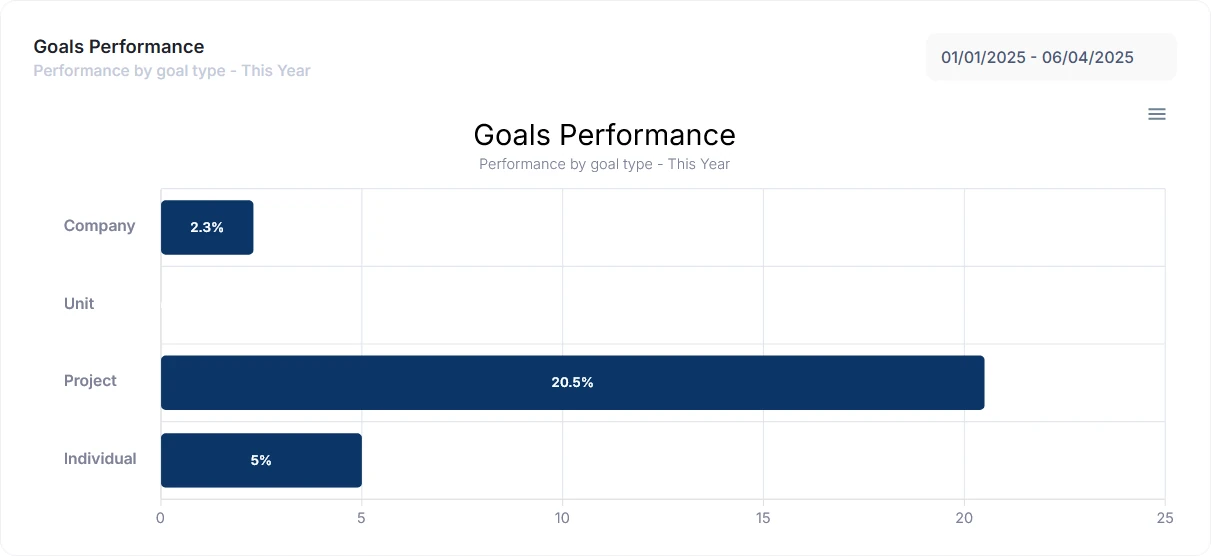
Drafts grounded in data. Managers own the words.
The AI doesn't write the review for you. It assembles the evidence and proposes phrasing — you decide what ships:
- Drafting pulls from OKR progress, 360° themes, prior-cycle commitments, and self-assessment
- Every claim in the draft cites its source — you can click through to the data point
- Self-assessment and manager-evaluation workflows with multiple rating scales
- Automated scheduling, reminders, and overdue tracking across the cycle
- Historical tracking — see how performance evolved across the last N cycles
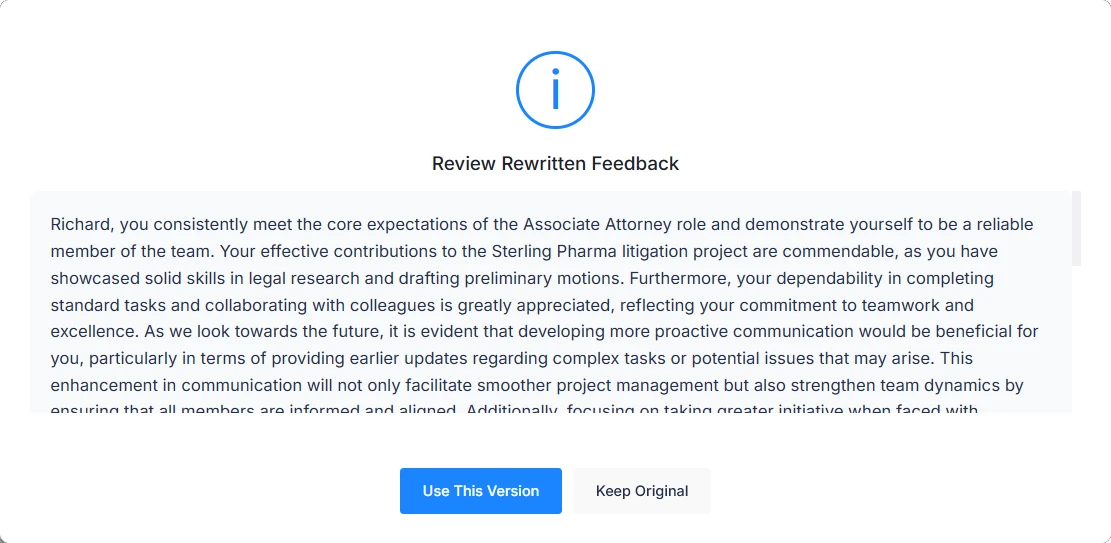
360° feedback that actually feeds the review.
Multi-source signal — anonymous where it matters, attributed where it doesn't:
- Inputs from supervisors, peers, direct reports, and cross-functional collaborators
- Anonymous-by-default for peer and report feedback — attribution rules configurable
- Themed synthesis: behaviors and skills aggregated across raters, not free-text dumps
- Surface contradictions across rater groups — where peers say one thing and reports say another
- Feeds directly into the AI evaluation draft as a cited source, not a separate report
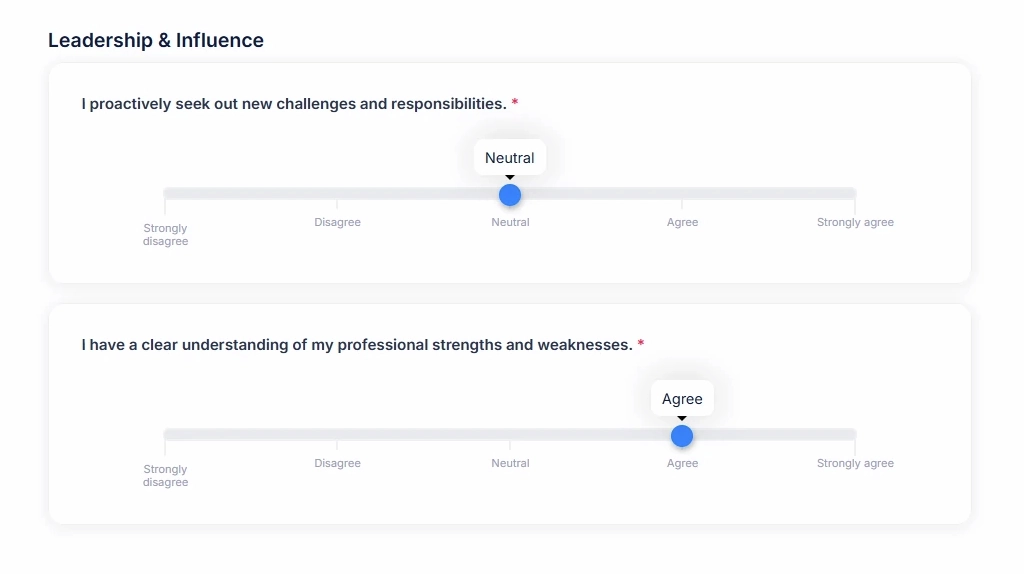
Dashboards for the people who actually decide.
Built for managers checking before a 1:1, and for execs walking into a board meeting:
- Real-time OKR progress and KPI tracking, with drill-down from org → team → individual
- Custom KPI definitions — financial, operational, talent, whatever you measure
- Trend views across cycles, with forecast lines on the in-progress quarter
- Side-by-side comparisons across teams, departments, regions
- Alerts on at-risk objectives and overdue reviews — push to email or workflow
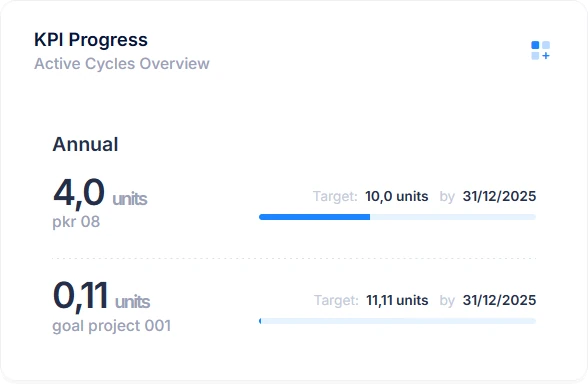
Built for the cadence you already run.
Same engine, different rituals. Configure the cycle, the rater set, and the calibration rules — keep the rest of the muscle memory your org has built.
Performance rituals supported:
- Quarterly OKR Cycles
- Annual Performance Reviews
- Mid-Cycle Check-Ins
- Manager 1:1 Templates
- Skill-Gap → Development Plan
- 30/60/90 Onboarding Targets
- Calibration Sessions
- Promotion Cases
- High-Potential Identification
- Performance Improvement Plans
- Stretch Assignment Tracking
- Cross-Functional Reviews
- Succession Planning
- Compensation Calibration
- Pay-Equity Analysis
- Leadership Pipeline
- Career Conversations
- Team-Health Pulses
Start Now
For any request, please contact us
Performance Management FAQ
What HR Ops, People Analytics, and Comp Committees ask first.
Does the AI write the review? Where's the human?
The AI assembles the evidence — OKR progress, 360° themes, prior commitments — and proposes phrasing the manager can use or rewrite. Nothing leaves the review window without an explicit manager save. Every sentence the AI proposes carries a citation back to its source data, so reviewers can audit why a claim was made.
What's the OKR framework here?
Standard OKRs — Objectives (what you want to achieve) with measurable Key Results — implemented at company, unit, team, and individual levels. The visual builder handles the cascade and parent/child linking; weighted progress rolls up automatically. We don't impose a methodology beyond OKR conventions, so you can adapt it to your house style.
How are cycles structured?
Cycles can be annual, quarterly, monthly, or custom. They nest — an annual cycle can contain four quarterly ones with their own KRs and check-ins. Each cycle carries its own evaluation rules, scheduling, and rater sets. Transitions between cycles are automated, with reminders for unfinished evaluations.
Can employees see and respond to their reviews?
Yes. Employees see their personal dashboard with goal progress, prior reviews, and development plans. Once a manager releases the evaluation, the employee can acknowledge it and add a written response that becomes part of the cycle record.
How does weighting and progress calculation work?
Goals carry weights expressing relative importance. Progress is a weighted average of KR completion, factoring in dependencies. The dashboards show both raw progress and risk-adjusted forecasts on the in-progress cycle — so a 50% KR with a known blocker doesn't read the same as a 50% KR on a healthy trajectory.
Can we customize evaluation forms and competencies?
Yes. Build different forms for different roles or departments. Define your own competencies and rating scales — Likert, percentage, custom anchors. The AI drafting layer adapts its phrasing to the form's structure, so a 5-anchor behavioral form gets different language than a percentile-ranking comp committee form.
What reports and analytics ship out of the box?
Goal completion rates, evaluation distribution across rating tiers, cycle-over-cycle trends, team and department breakdowns, calibration drift, KPI tracking. Exportable as CSV, PDF, or scheduled to land in inboxes. Custom reports via the analytics module for People Analytics teams.
How is sensitive review data secured?
Access enforced at retrieval — managers see their direct reports, skip-levels see two layers, calibration committees see the cohorts they're calibrating. 360° anonymous responses are stored with rater identity stripped at write time, not just hidden in the UI. Full audit log on every read and edit, exportable for SOC 2 review.
Want a walkthrough on your cycle structure?
Contact Sales
