Catch burnout signals
before the exit interview.
Validated OLBI assessments, workload and engagement signals, and AI-driven follow-up probes. People Ops sees the early risk patterns — not just the resignations.
Where is burnout risk highest in Engineering this quarter?
AI
The Platform sub-team scored highest on OLBI disengagement (mean 3.8 / 5) — up 0.6 from Q1. Also: 41% are working ≥10h overtime weekly, sustained for 6 weeks. Engagement on the team pulse dropped 14 points over the same window.
Anything that points to a cause?
AI
Anonymous follow-up probes returned three recurring themes: scope creep on the migration project, on-call rotation gaps, and ambiguous ownership after the March reorg. Suggest a confidential cohort interview — I can schedule it under the existing Wellbeing program if useful.
Validated instruments. Not vibes.
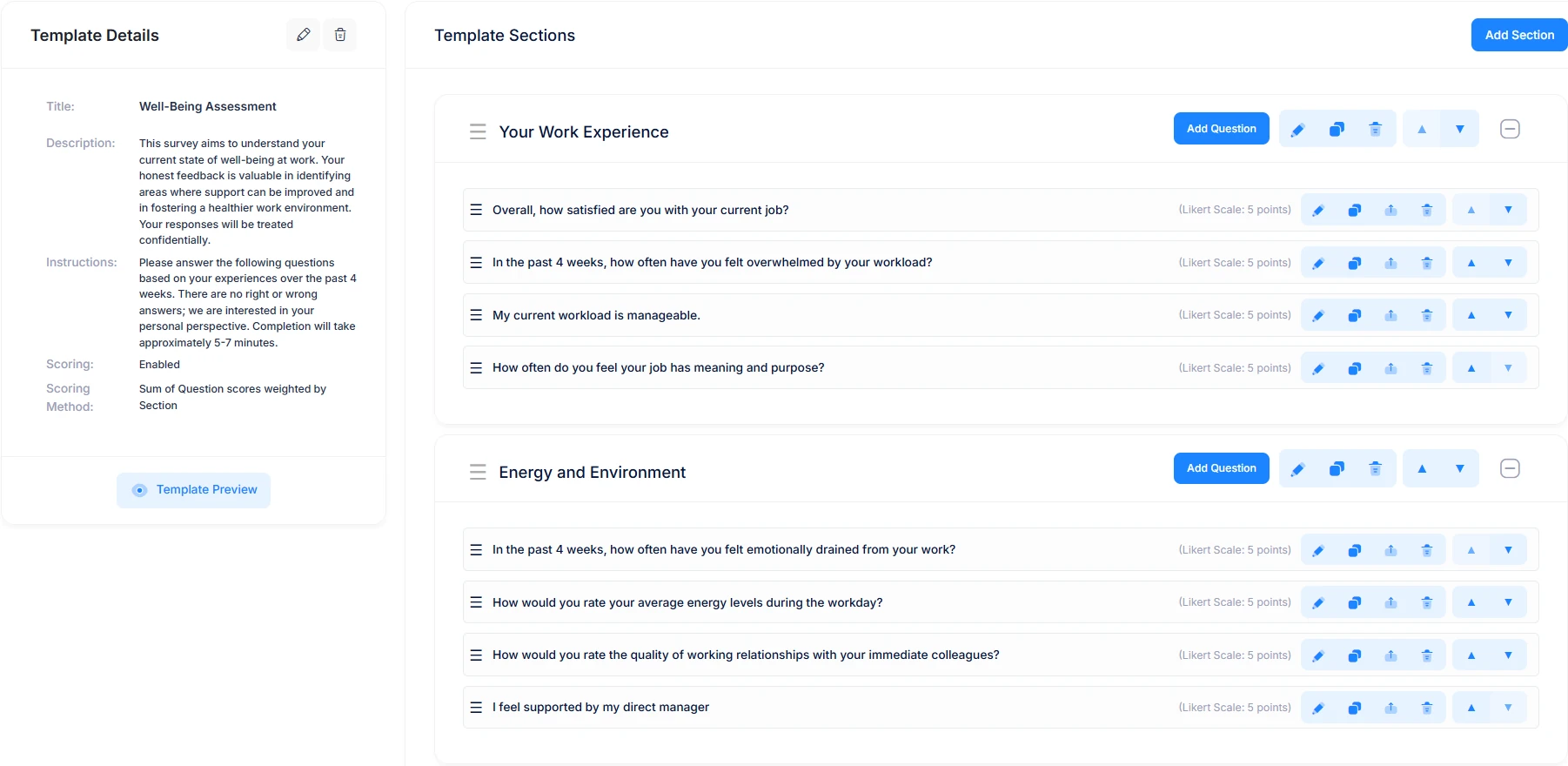
Burnout measurement that holds up to scrutiny:
- OLBI (Oldenburg Burnout Inventory) — disengagement and exhaustion subscales
- Maslach Burnout Inventory components available where licensing allows
- UWES engagement scale as the inverse signal — both sides of the spectrum captured
- Workload and overtime ingest from your time-tracking or HRIS — not self-report only
- Demographics for segmentation: team, tenure, role, region. Anonymized at write time
Probes that follow the signal.
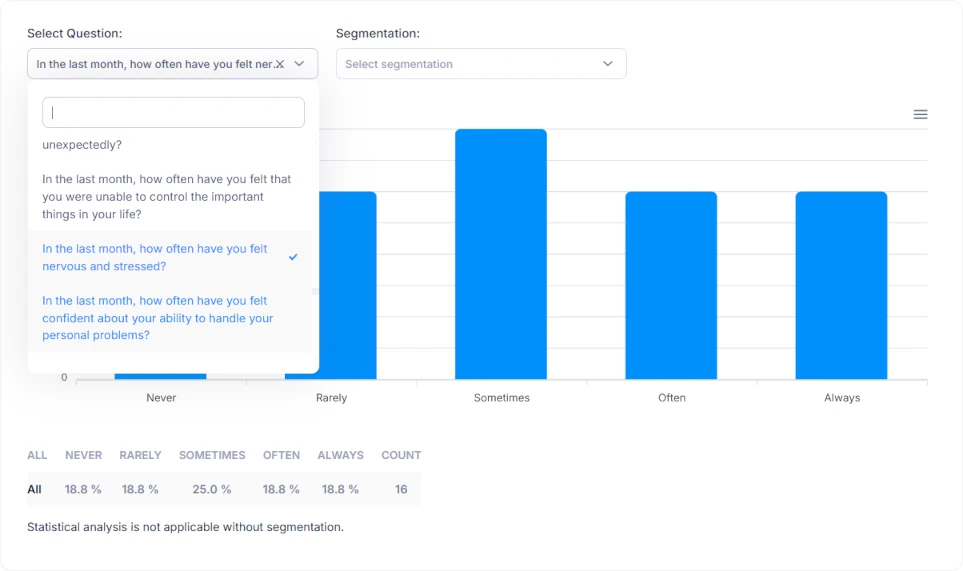
When scores drop, the AI doesn't just chart it — it asks why, in a way the team will actually answer:
- Auto-trigger anonymous follow-up interviews when a cohort's score crosses threshold
- Adaptive questioning: the agent probes specifics rather than rerunning the same form
- Theme synthesis: aggregates causes across respondents — workload, ambiguity, on-call, reorg
- Risk-flag escalation to HR / line managers with the cohort summary, not individual responses
- Identity-stripped at storage — anonymous-by-default means anonymous in the database
Intervention that doesn't out the individual.
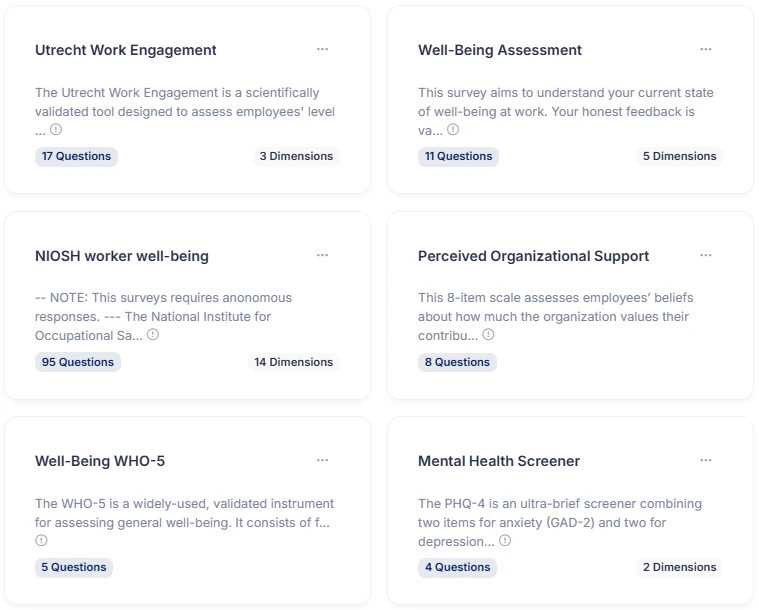
The dashboard surfaces cohorts and patterns — never names or single responses. Managers act on team-level data, not personal disclosures:
- Cohort-level heatmaps by team, tenure, role, region — no individual identification
- Cohort minimum sizes enforced before any aggregation is shown
- Trend lines across cycles so you see direction, not snapshots
- Suggested interventions tied to the dominant theme (workload, ambiguity, on-call, etc.)
- Audit log on every dashboard view — exportable for compliance
Where the prevention loop runs.
Common burnout programs people run in production.
- Quarterly OLBI Pulse
- Engineering On-Call Watch
- Sales Quota Stress Check
- Post-Reorg Health Pulse
- Manager Burnout Audit
- High-Performer Watchlist
- New-Hire 90-Day Check
- Return-to-Office Adjustment
- Compliance & Healthcare Cohorts
- Pre-Exit Risk Signal
- Anonymous Cause Probe
- Cross-Cohort Comparisons
- Healthcare-Cost Correlation
- Manager Coaching Trigger
- Compliance & GDPR Reporting
Start Now
For any request, please contact us
Burnout Program FAQ
What HR, Legal, and Works Councils ask first.
How anonymous is anonymous?
Identity is stripped at write time, not just hidden in the UI. The database stores responses without rater ID. Cohort minimum size enforced before aggregation — typically 5 or higher. No path back to the individual exists.
Why OLBI rather than another scale?
OLBI is open-licensed, validated across many industries, and captures disengagement and exhaustion separately — which matters because they require different interventions. MBI is available where you hold the license.
Can managers see individual responses?
No. Managers see aggregated cohort summaries and themes — never individual responses, even when they technically would be able to deduce them. Cohort-size enforcement blocks any aggregate that would identify a single person.
What workload signals are ingested?
Overtime hours, on-call rotation density, calendar load, sprint-velocity drops, time-off accrual vs. usage. Pulled from your HRIS, time-tracking, and ticketing systems — whatever you connect.
How does the probe stay supportive, not interrogative?
The interview agent uses a wellbeing-trained persona — open questions, no leading framings, no pressure to specify the manager. Participants can decline any question and the agent acknowledges it. Tone is configurable to match your culture.
Is this GDPR / Works-Council compatible?
Yes — anonymous-at-write, cohort minimums, full audit log, exportable consent records, right-to-delete at cohort and conversation level. We work with the works council to set thresholds before launch.
Want to scope a program with us?
Contact Sales