The org chart you can't draw.
Every organization has a real structure the formal chart hides: who people trust, who quietly carries the team, who's drifting toward the exit. KS-Agents quantifies it — anonymously, cyclically, at board-readable resolution.
AC
Trust Network · Acme Corp
Anonymous mode
Engineering · Product · Sales
0/247 nodes
0 edges
Computing trust graph from 312 evaluations…
Participants
247
94% response rate
Trust ties
0
Reciprocal, scored 1–5
Hidden connectors
0
Off the org chart
Isolation risk
0
Q2 attrition signal
Knowledge Index
0%
How well people know each other
Trust Index
0%
Avg. trust score, weighted by ties
Reliability Index
0%
Consistency across raters
Influence Index
0%
PageRank-weighted authority
Trust distribution by rater group
Share of evaluations at each score level (1–5)
AI InsightsAI
Patterns extracted from 247 participants and 312 trust evaluations, cohort-level only
3 informal leaders found outside management
Three senior ICs in Engineering account for 41% of incoming trust ties, and none of them are line managers. Natural champions for change programs.
Data Infra is drifting away from the network
Post-acquisition cohort with 0.72 isolation score and a 0.4-pt trust drop quarter-over-quarter. Pattern consistent with senior IC departures within two quarters.
Cross-unit trust up 12% after the Q4 reorg
Two new bridge people emerged between Platform and Product. The reorg is taking, but the bridges sit at the same level. Watch for burnout.
The trust layer your org chart hides.
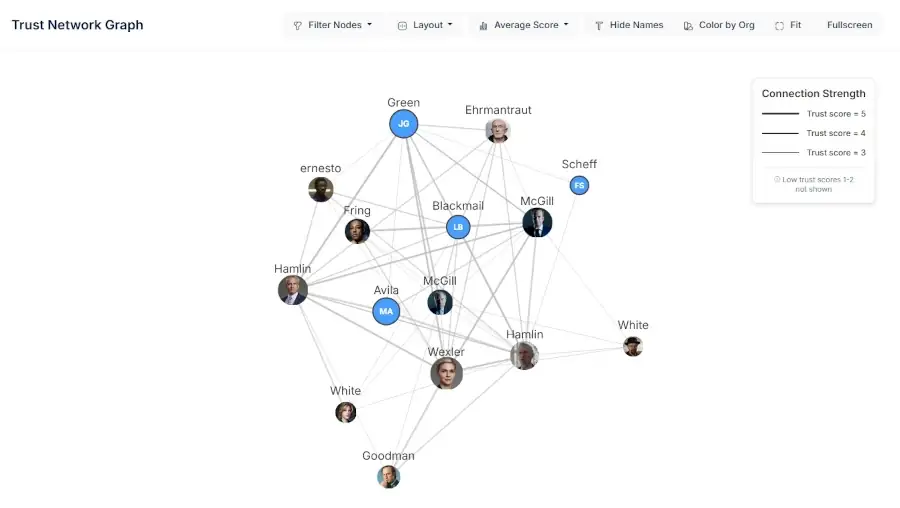
Map the relational network — not the formal hierarchy:
- Hubs: who do colleagues turn to for advice, escalation, validation?
- Bridges: who connects otherwise-separate sub-networks?
- Isolation: which teams or individuals are weakly connected — early signal for departure or disengagement
- Direction: trust flows both ways; the agent maps reciprocity, not just nomination
- Change over time: same scan every quarter shows how the network reshapes after reorgs, hires, departures
Trust signal, ethically captured.
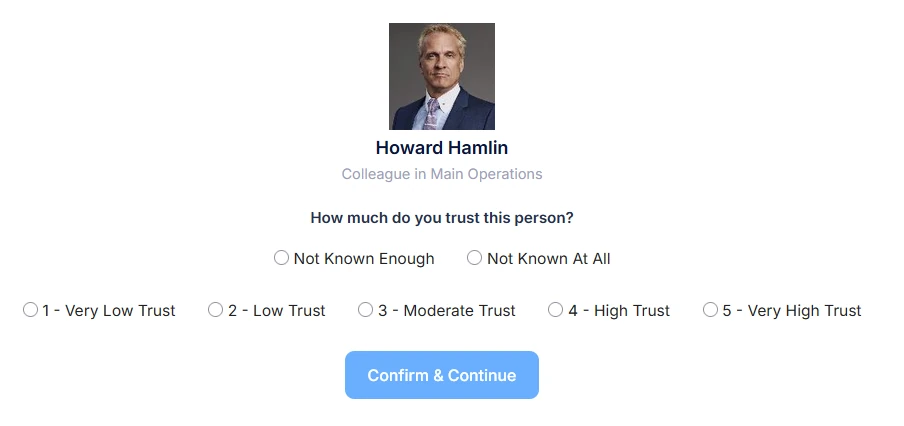
Network analysis lives in a sensitive space. The constraints are the design:
- Consent recorded before any participant nominates anyone
- Cohort minimum sizes enforced before any visualization — no “three people pointing at one person” reveals
- Individual maps visible only to the individual; managers see team-level structure
- Anonymous nomination mode available — see the structure without seeing who pointed at whom
- Right-to-delete honored — a person can withdraw and their edges disappear from the map
Reads beyond the map — into action.
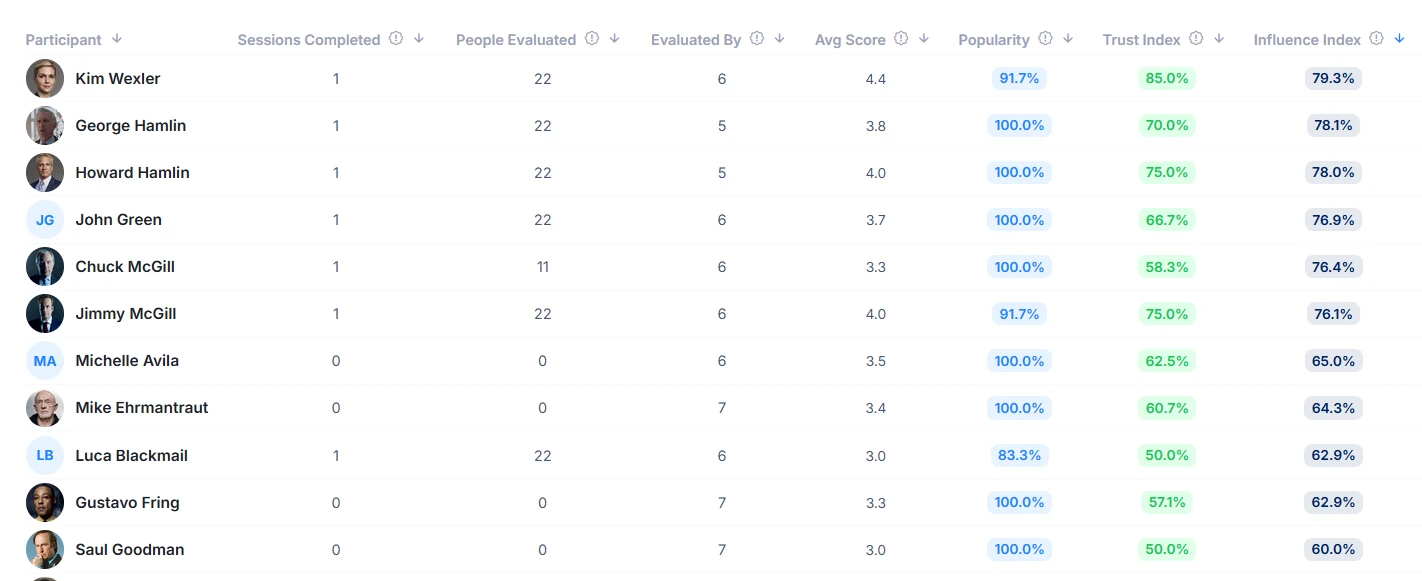
The trust scan plugs into the rest of the platform, so the insight doesn't sit in a PDF:
- Change-management programs: hubs and bridges identified as natural champions or risk points
- M&A integration: which legacy networks survived the integration, which dissolved
- Succession: hubs that lack formal seniority but carry the institutional knowledge
- Retention: isolation-risk individuals flagged as cohort, with anonymous follow-up offered
- D&I: connectivity gaps across demographics that the org chart obscures
Where the trust map pays off.
Programs where knowing the relational network changes the decision, not just the slide.
- Reorg Champion Mapping
- M&A Integration Watch
- Informal Leader Discovery
- Isolation-Risk Watchlist
- Succession Planning
- Cross-Functional Bridge Analysis
- Inclusion-Connectivity Audit
- Post-Reorg Trust Pulse
- New-Hire Integration Tracking
- Pre-Departure Network Loss
- M&A Cultural Diligence
- Innovation-Source Detection
- Quarterly Trust Trend
- Mentor-Match Suggestions
- Works-Council Reporting
Start Now
For any request, please contact us
Organizational Trust FAQ
What HR, Legal, and the works council ask first.
Is this surveillance?
No — it's voluntary nomination with explicit consent. Participants choose to name colleagues they trust on specific dimensions (advice, escalation). They can opt out, decline individual prompts, or withdraw their data. The org never sees individual nominations — only structure-level summaries.
Can a manager identify who pointed at whom?
Not in anonymous mode — only aggregated edge counts are stored. In attributed mode, individuals see their own incoming nominations; managers see only structural views (hubs, bridges, isolation) of their team, never the underlying pointers.
How often should we run a scan?
Twice a year is the common cadence — enough to see post-reorg or post-acquisition shifts, not so often that participation fatigue sets in. Quarterly works for fast-changing orgs.
What's the response burden?
~5 minutes per participant. Short prompts about who you'd ask for advice, escalation, or validation in specific scenarios. No long survey. Mobile-friendly, multilingual.
How is this different from a regular ONA tool?
Three differences: (1) the trust scan is wired into the rest of your data — engagement, performance, interviews — so insights feed each other; (2) the AI analyst can answer questions about the network in plain language; (3) privacy controls are first-class, not a configuration buried in an admin panel.
Is this GDPR / Works-Council compatible?
Yes — explicit consent records, cohort minimums, right-to-delete, full audit trail, Article 30 records auto-generated. We work with the works council to set thresholds before launch.
Want to scope a scan with us?
Contact Sales